

(Date: November 18, 2025)
Today was a watershed moment for the digital world.
If you tried accessing certain popular websites, you might have been met with a chilling message: “500 Internal Server Error.” This wasn’t a localized issue or a minor bug. It was a global alarm bell, triggered by a significant network outage at one of the internet’s most critical, yet least-known, players: Cloudflare.
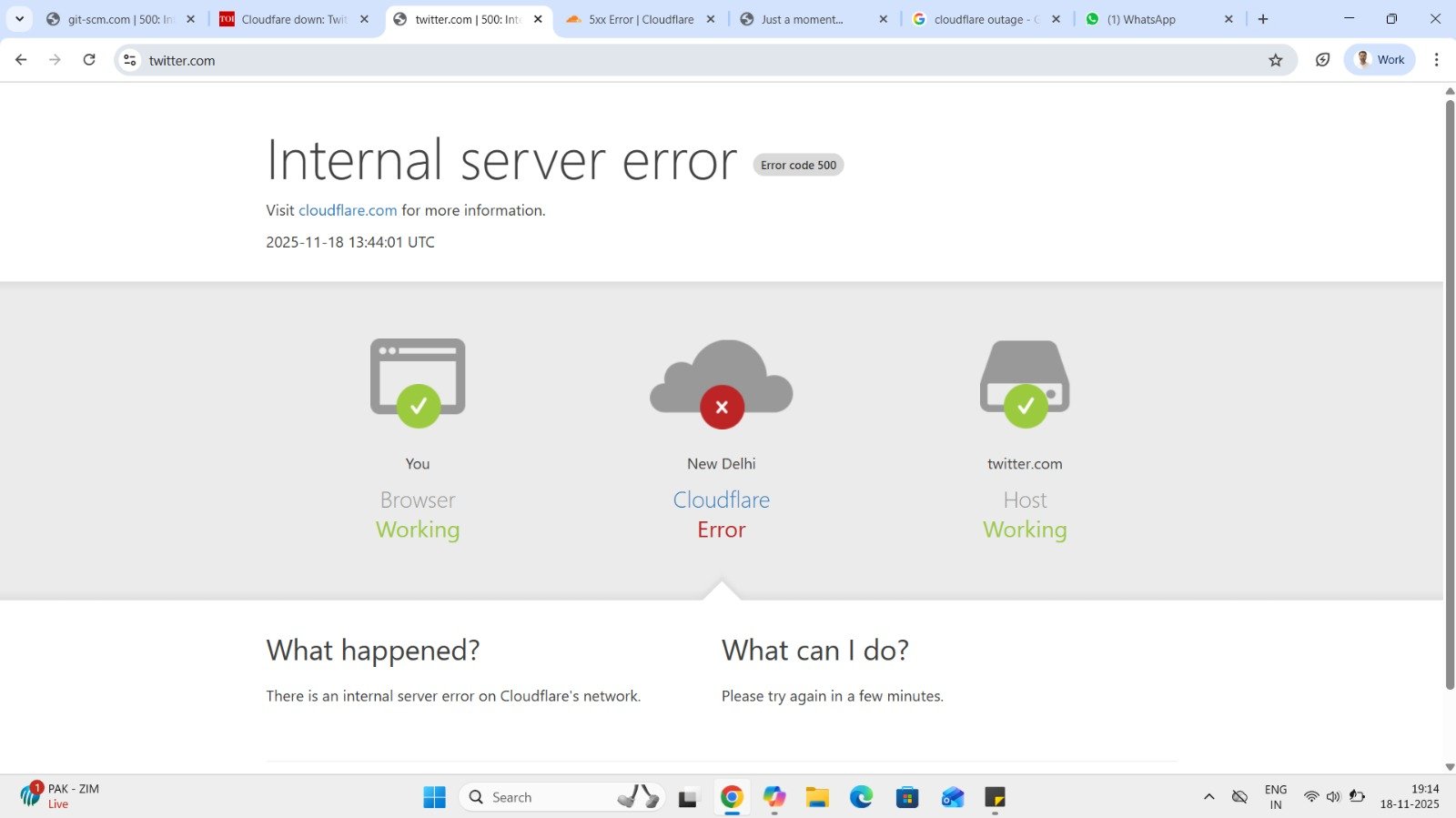
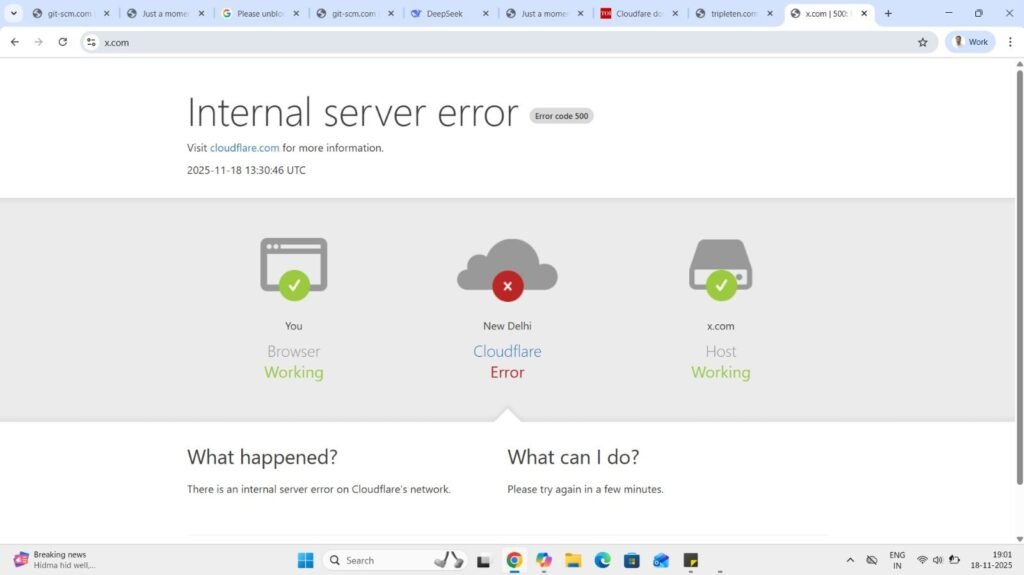
As you can see in the screenshots circulating online (and provided by a reader), the error pages affected enormous platforms. For a moment, giants like X (formerly Twitter) and parts of ChatGPT were effectively inaccessible.
This event is more than just “breaking news.” It’s a deep, immediate lesson in the fragility of modern internet infrastructure and the critical need for resilience.
What Actually Happened? The Cloudflare Cascade
Cloudflare is a Content Delivery Network (CDN), a DDoS mitigation service, and a DNS provider. In simple terms, they act as the security guard, traffic cop, and speed booster for a massive percentage of the internet.
The outages today confirmed the fault was within Cloudflare’s own network, which instantly triggered the 500 Internal Server Error for sites that rely on their edge services. The diagram we saw—showing the user’s browser as ‘Working’ and the host’s server as ‘Working,’ but Cloudflare as ‘Error’—perfectly illustrates the problem: the vital middleman was down.
Key Takeaway: The Hidden Centralization Risk
The core issue this exposes is Centralization Risk.
We often talk about the cloud being distributed, but beneath the surface, many major services rely on a small handful of dominant infrastructure providers. When one of these critical single points of failure experiences an issue, the ripple effect is immense and instant.
If your entire security, performance, and routing layer is dependent on a single vendor, you are exposed to their downtime, regardless of how robust your own servers are.
3 Critical Lessons for Every Business Leader and Engineer
The Cloudflare outage should prompt an immediate audit of your own digital strategy. Here are three things you must consider:

- The Necessity of Multi-CDN Strategy
For any enterprise with high traffic or high-stakes operations (e-commerce, financial services, media), relying on a single CDN is a vulnerability.
- Actionable Step: Explore a Multi-CDN strategy. This involves using two or more different CDN providers (e.g., Cloudflare and Akamai, or Cloudflare and Fastly) and intelligently routing traffic between them. If one goes down, traffic automatically switches to the other.
- Don’t Let DNS Be a Single Point of Failure
The Domain Name System (DNS) is the phonebook of the internet. If your DNS provider fails, no one can find your website, even if the site itself is operational.
- Actionable Step: Implement multi-provider DNS. By hosting your DNS records with two separate, geographically diverse providers, you ensure that if one service fails, the other can continue resolving traffic.
- The Shift from Cost to Resilience
In many IT decisions, the cheaper solution often wins. The events of today illustrate why chasing the absolute lowest cost in critical infrastructure can lead to catastrophic losses during a downtime event.
- Actionable Step: Calculate your Cost of Downtime (CoD). Use this number to justify investments in redundancy, multi-vendor solutions, and advanced Site Reliability Engineering (SRE) practices. A few hours of downtime can cost infinitely more than the annual fee for a second backup provider.
The Way Forward
Infrastructure events like this are the price of a deeply interconnected digital world. While Cloudflare’s engineers will work tirelessly to prevent a recurrence, the ultimate responsibility for resilience lies with the companies that use these services.
Today’s outage was a wake-up call. It’s a reminder that engineering principles must prioritize fault tolerance and redundancy over convenience.
What is your company’s plan for the next unexpected infrastructure failure? Share your thoughts and strategies in the comments below.
Found this analysis helpful? Subscribe to arvindgupta.co for more insights on technology strategy, resilience, and digital transformation.